


Big cities in India have long promised the pot of gold. Economic power centres connected to each other, they have appropriated a disproportionate share of talent, business and development. However, in recent years, a shift has been taking place, with smaller towns emerging as catalysts of growth, particularly for brands seeking to expand their reach and add new sets of consumers.
Growth spurt of small towns
We had started noticing the rise in aspirations in the small town India almost a decade back during our multiple researches that took us across the country. Few megatrends were fueling this rise. The liberalization boom of the 90s and early 2000s made the metro cities hubs of development and a magnet for professional migrants from smaller towns. A majority of Indian middle class (typically men) brought up to strive for professional and financial progress, placed high premium on big city living.
However, Indian small towns are deeply traditional, and a person brought up here remains traditional at heart, even when aspiring for modern progress. The big cities, while great for economic and professional growth, do not provide the strong sense of connection to culture, tradition and community as is the case in smaller towns.
At the same time, rapid unplanned urbanization and poor urban governance in metros resulted in unwieldy, sprawling cities. The residents in metros face a number of challenges, including overpopulation, inadequate infrastructure, and pollution. There is a lack of public education, healthcare, and equitable job opportunities. As a result, these cities are becoming increasingly unequal. The declining standard of living in these cities puts a strain on the health, safety, and productivity of a large majority of the urban population.
With time, costs of living in metros spiraled up, while income growth did not keep pace. There also was (is) a constant threat to jobs, compounding the stress of big city life. In a nutshell, life in a metro had begun to loose its sheen a few years back itself.
Fortunately, rapid advancements in connectivity – internet, road, air – have brought smaller towns in sync with the bigger cities. As modern, prestigious job opportunities are getting created in smaller towns, educated professionals are also opting to stay in their hometowns rather than aspiring to big city lives. The growth of industry and residence of educated professional class in smaller towns have a cascading effect on business activities as well. The lockdown and the resultant work-from-home or job losses have provided further impetus to small town living by people who would otherwise have been in metros.
Data from a variety of sources supports attractiveness of small town India:
📈 Rising Internet Penetration
Internet penetration in rural India increased by over 260% from 2014 to 2022. (Source: Statista)
📱High Smartphone Adoption
Over 60% of rural Indians now own a smartphone. (Source: KPMG)
💰 Increasing Disposable Incomes in Rural India
grown at an average rate of 7.5% between 2014 and 2022. (Source: World Bank)
Small Towns: Big Potential
WIth a larger proportion of Indian population coming from smaller towns in India, they will continue to be hotspots of growth for brands. The population of smaller towns in India is expected to reach 840 million by 2030, accounting for over 60% of the total population. (Source: McKinsey & Company). Because these towns are relatively new to the brand consumption journey, they represent immense untapped market potential. According to Bain & Company the untapped market potential in smaller towns is estimated to be worth over US$2 trillion by 2030.
This potential is evident in the growth of online spends by people in small town. People in smaller towns are increasingly becoming more digitally savvy. This is due to a number of factors, including the growing disposable incomes of consumers in tier 2 and tier 3 towns, the increasing penetration of smartphones and internet access in these areas, and the growing popularity of e-commerce platforms among consumers in these towns. Consumers in small towns are using digital channels to overcome their lack of access to physical branded stores. Brands can really leverage digital platforms to engage with consumers from small towns.
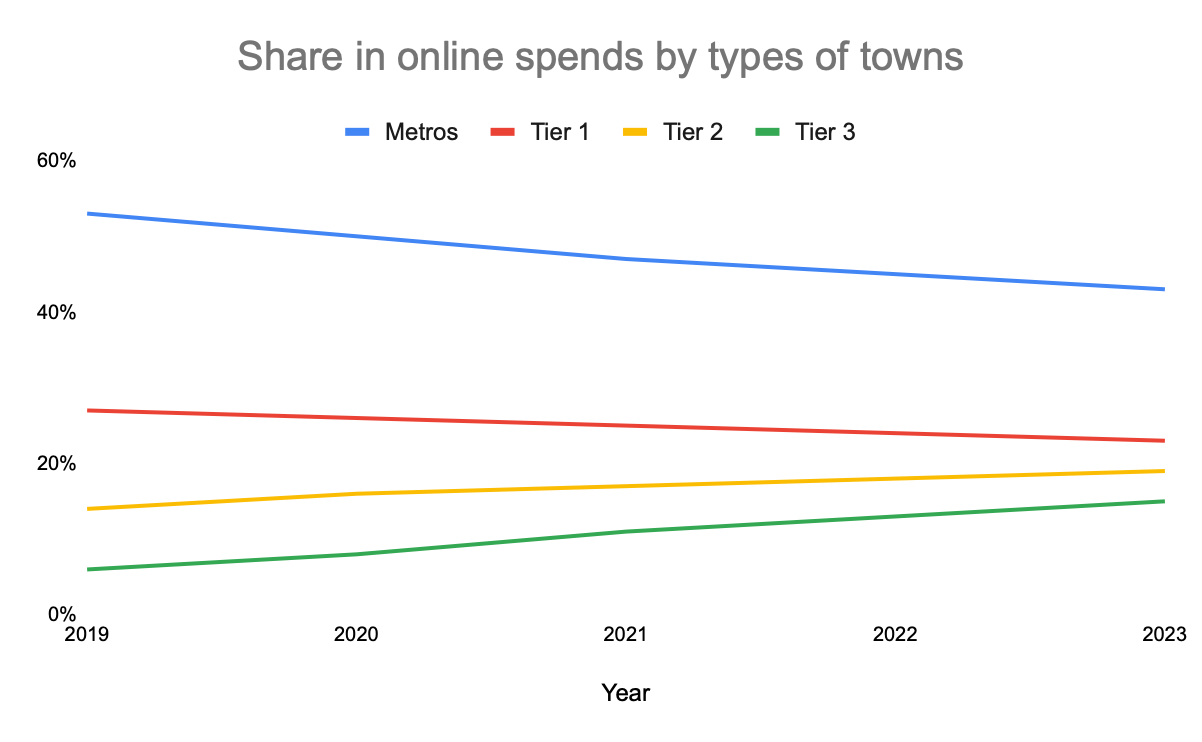
Smaller towns in India are no longer mere hinterlands; they are emerging as vibrant hubs of economic activity and consumer demand. Brands that recognize and adapt to this changing landscape will find themselves at the forefront of a new wave of growth, driven by the aspirations and purchasing power of the small town consumer. By embracing the unique dynamics of smaller towns and tailoring their strategies accordingly, brands can unlock a vast untapped market and play a pivotal role in India’s inclusive growth story.
Contact us at monika@higheratwork.com if you have any questions.
Great post! It’s fascinating to see how smaller towns in India are becoming catalysts of growth and attracting brands to expand their reach. I’m wondering, what are some specific strategies that brands can use to effectively engage with consumers in these smaller towns and leverage the digital platforms available?