All marketers talk of customer journeys.
They are immensely useful to design effective solutions for different customer groups at various touch points. When understood well, customer journeys can help effectively deploy marketing budgets and activities to achieve business objectives. Deep insights into customer journey can help us understand various need-gaps and compromises faced by customers. This opens up the possibility of building superior customer experience, differentiation and innovation.
However, real customer journeys are difficult to grasp, and run the risk of getting creative minds bored soon!
For ease and clarity we build linear visual representation of customer journeys but in reality a customer does not follow a linear path. There are unexpected diversions and it is difficult to communicate them all. At times, even the customers are unaware of potential diversions. So a customer journey map is at best an approximate understanding of the customer’s journey from ‘Awareness to Experience’.
Customer journeys are also quite tedious to collate and brainstorm around. Unlike intellectually stimulating and creative concepts like Brand Positioning and Brand Personality, it is difficult to get a group excited about mapping a customer journey and potential touch points!
However, customer journeys are the most pragmatic and actionable part of brand development and are an absolute must for consistent brand differentiation.
Components of a customer journey
Customer Segments
Different customer groups exhibit different behaviours that is reflected in their purchase journeys too. An understanding of key customer segments is important to map the customer journeys accurately. It has direct implications on marketing actions at various touch points for target customer segments.
Purchase stages
A customer goes through a process to buy and experience a product or service. The stages in this process are universal, though there are some differences in different frameworks that are used to map customer journeys. We have been using a purchase process framework that includes the following stages:
- Trigger: Something that starts the customer off, consciously or sub-consciously, to start thinking about a purchase. This could be an event, a thought, a visual, a recommendation or something else.
- Consider: When the customer decides to act on the trigger, she begins to consider the options for purchase. She may think of different options – products, brands, alternatives. For many brands the question is how to get into the set that the customer considers for purchase.
- Search: The customer may then pursue the process, looking for more information about the options she has under consideration. New options may enter the consideration set as she finds more information. The sources of information are varied, depending on the category and customer segment. Usual avenues for information these days are search engines, social media, youtube, dedicated forums, dealers and retailers, friends & family. Brands that do well, make it easy for the customer to find relevant information. They also have insights into specific information areas that the customer struggles with and provide help at the right time.
- Choose/Buy: Customer gets closer to purchase and chooses from among her options. New options can enter the set, even at this stage. She then actually makes the purchase. The purchase decision is influenced by what she has already chosen and experienced in the process, or some intervention at the moment of purchase. Brands that provide a seamless and superior purchase experience at this stage are at an advantage. Insights into customer expectations and criteria for final selection at the point of purchase enable a brand to do that.
- Experience: Customer’s experience of the product or service impacts her future purchases. She may share her experience to influence other customers too. Other than the quality of the product itself, after sales services and customer relationship management play an important role in determining customer’s experience of a Brand.
Customer Touch Points and Communication Vehicles
Customer interactions with a Brand can happen at various places, in the physical and digital world. An understanding of these touch points offer Brand effective communication opportunities by bringing together the customer journey stage and the nature of touch points. For instance if a Brand knows that its target customers rely on social media to gather options at the ‘Consider’ and ‘Search’ stages, but prefer to make the purchase in physical stores, the Brand needs to develop a seamless Omnichannel strategy to meet their needs.
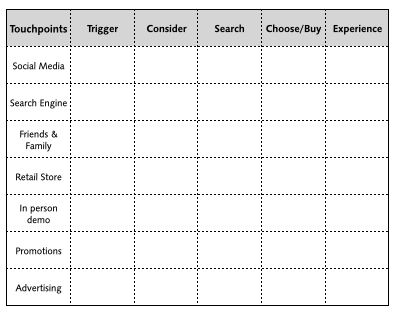
A deep understanding of the customer journey helps marketing teams immensely. It is an invaluable tool to developing effective and pragmatic marketing plans. Customer journey maps or tables can be developed using customer conversations, observations, online behaviour tracking etc. In most of our projects across categories and geographies, customer journeys (or purchase processes as we call them) have proven to be key to successful brand and marketing strategies.